A note on this document. Everything below is a first-hand record kept contemporaneously since the issue began. Emails and call notes are reproduced as they were written at the time. Personal information (serial numbers, phone numbers, email addresses, home addresses and family members' names) has been redacted. Apple employees are referred to by role and initial rather than by name; they have been, for the most part, courteous and diligent, and the failure documented here is an institutional one, not a personal one.
Identical redaction labels mean identical values in the source. Where you see [SERIAL-B] twice, the two records genuinely carried the same serial number.
The short version
- Since September 2025, AirTags registered to my Apple Account have silently detached from it. They vanish from Find My on every device I own, and from iCloud.com, with no notification, no email, and no entry in any log I can see.
- The AirTags do not stop working. They stay live on the Find My network. Where I have shared them with my wife, they remain visible on her account, still labelled as shared by me, with a "last seen" timestamp frozen at roughly the moment they left my account.
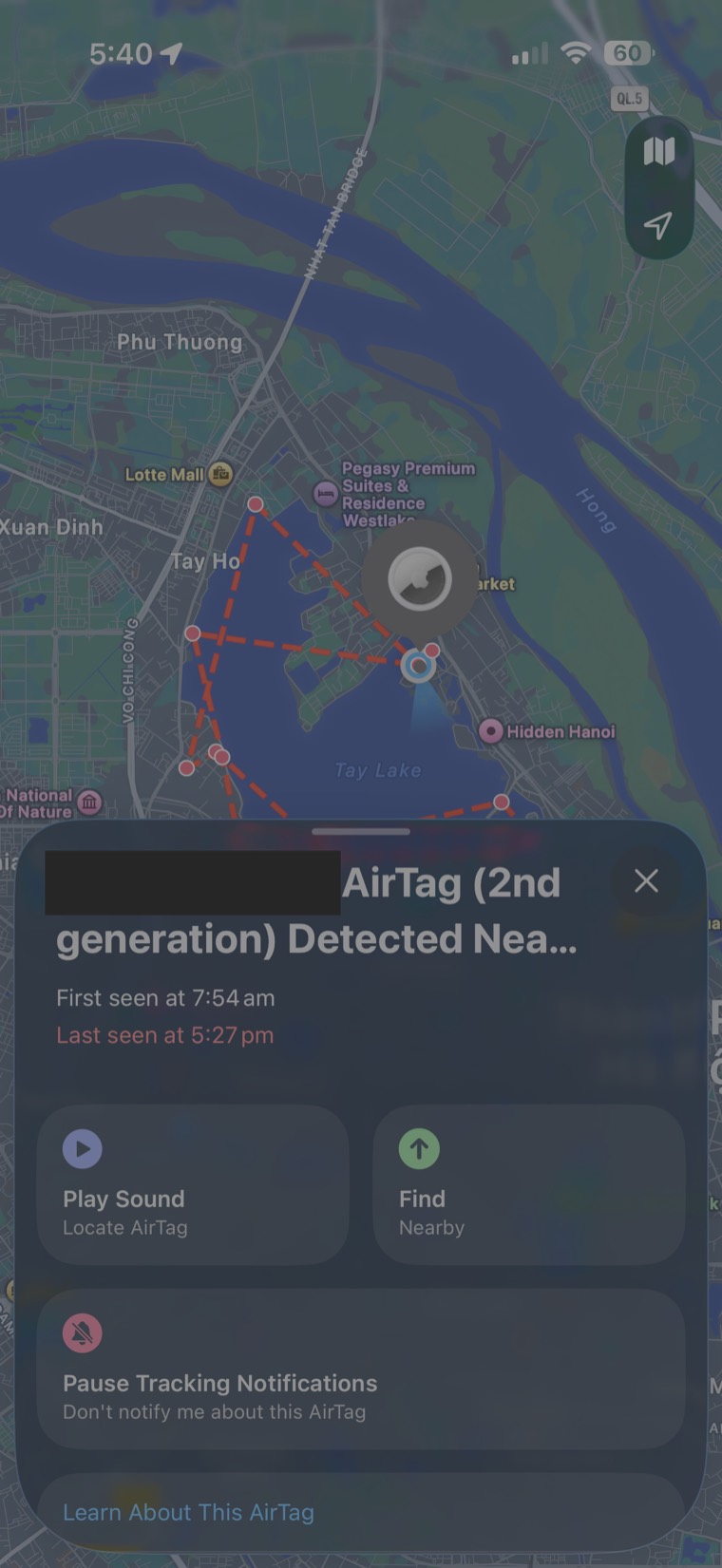
- The only outward symptom is the anti-stalking behaviour: an orphaned tag starts chirping when moved, and eventually your family and the strangers around you start receiving "an AirTag is travelling with you" alerts. The failure announces itself as a stalking alert, not as an error.
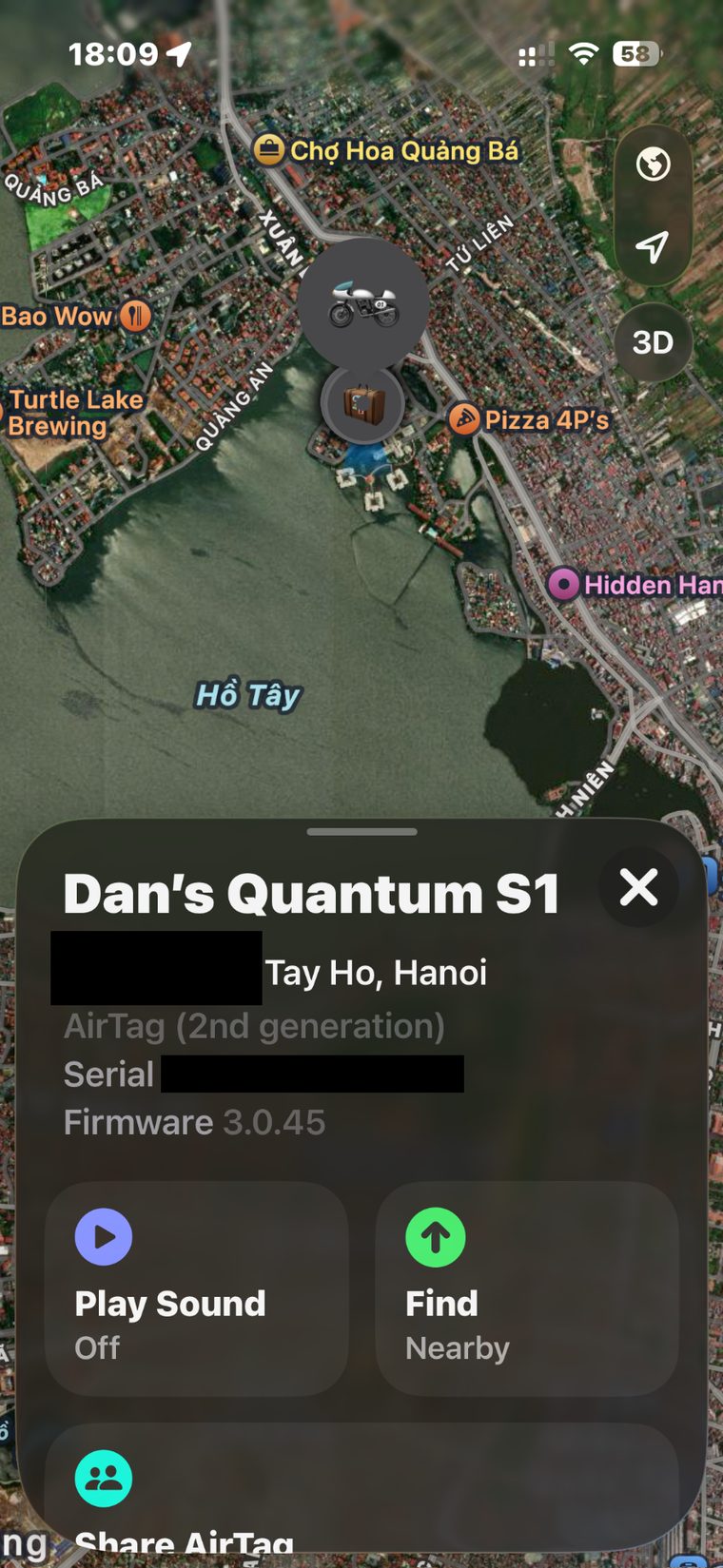
- This has now happened five times in a year, and it has hit both generations of AirTag: years-old first-generation units on firmware 2.0.73, and a four-week-old second-generation unit on firmware 3.0.45. Different chip, different firmware, same failure. Apple redesigned the hardware in between and the behaviour followed my account across.
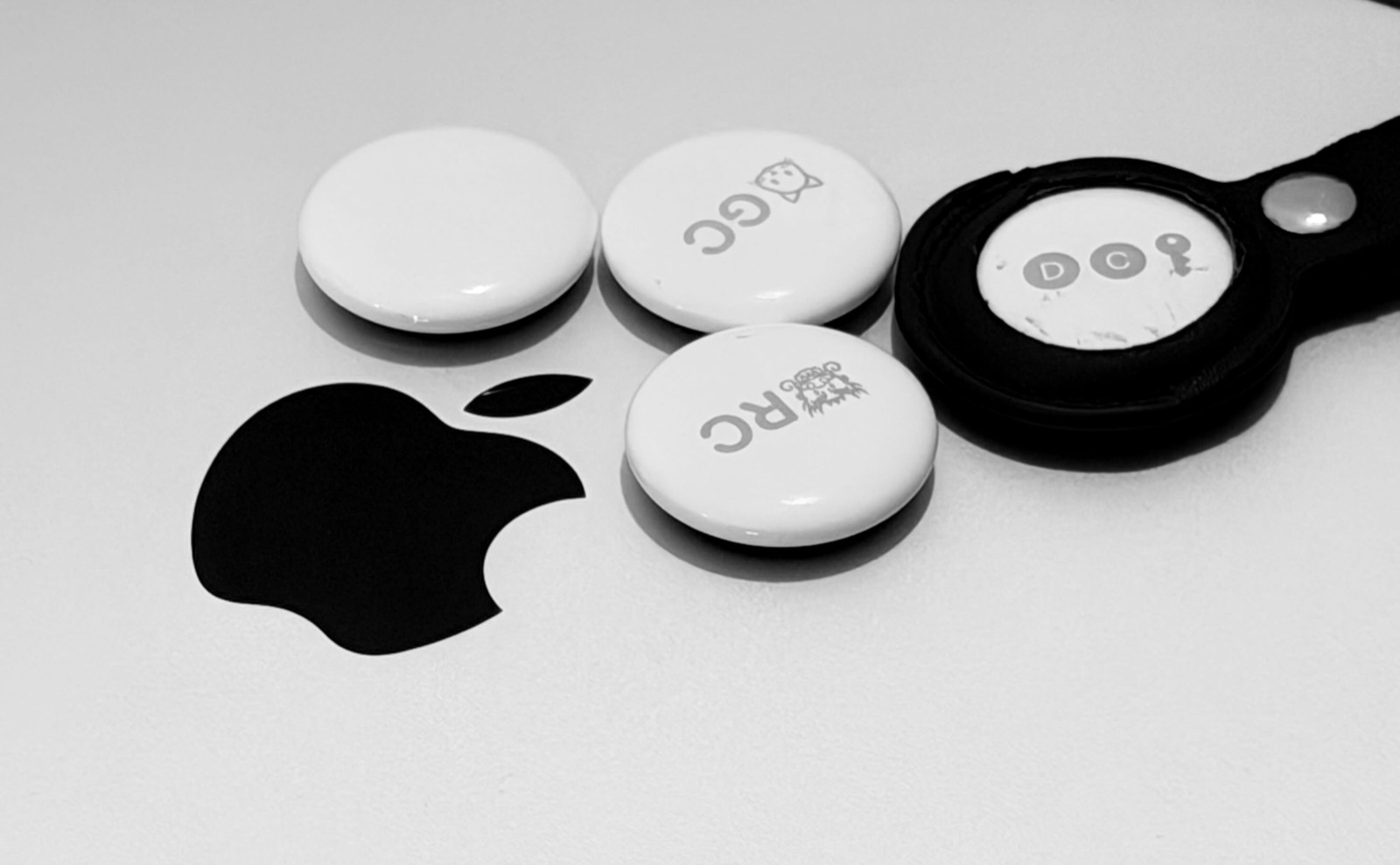
- The first occurrence took every AirTag I owned. At least twelve of them, in September 2025, all at once. I did not count them at the time, so twelve is a floor rather than a total. Most were never put back on the account. Of the few that were, several went back only in February 2026, when they turned up in our luggage as we packed for a flight, and four of those dropped off again within days. A four-week-old second-generation tag dropped off in June. That is at least eighteen separate drop-offs, across fourteen or more individual tags, in a year.
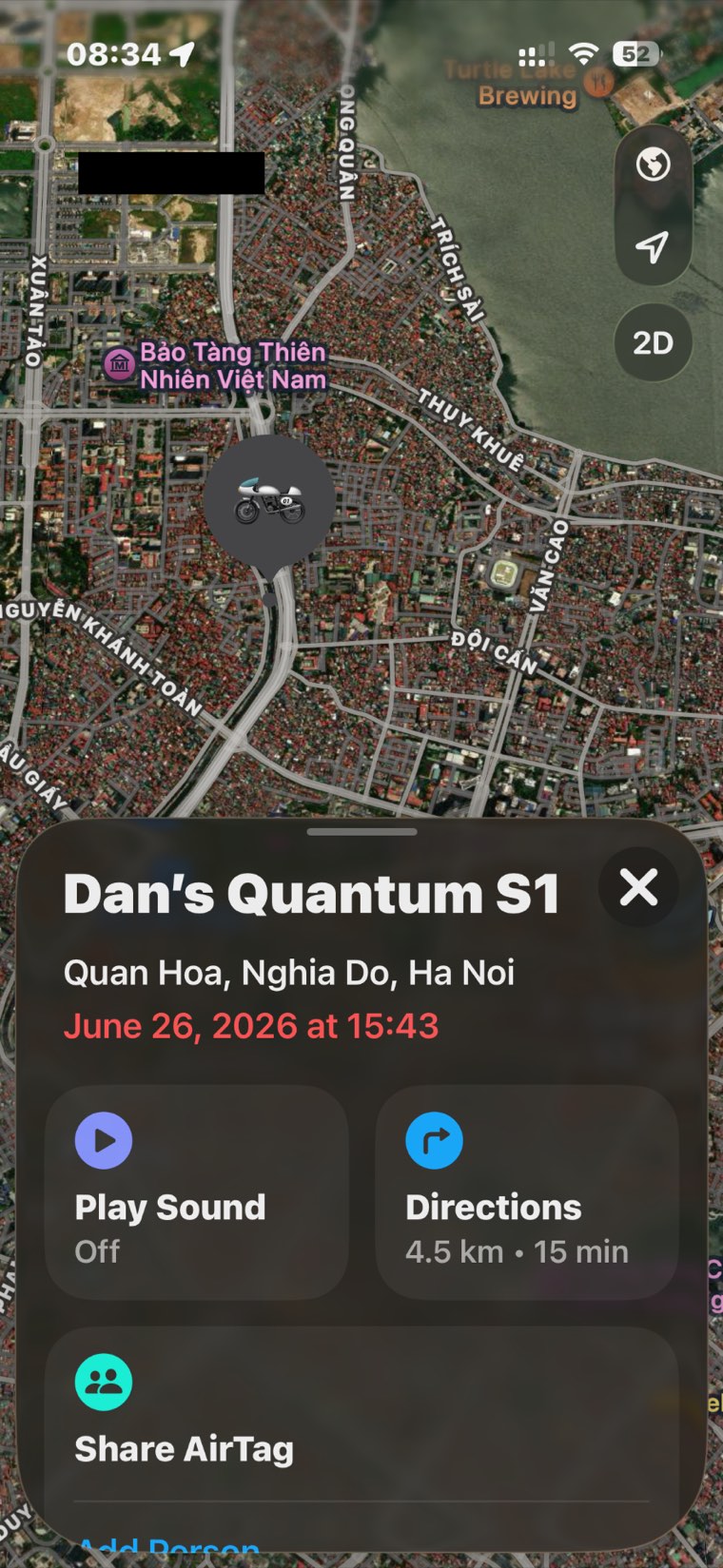
- It happened again on 7 September 2026, in a different form. Every AirTag my wife shares with me, including the one in my son's school bag, stopped reporting a location on my account while continuing to report normally on hers. The second-generation tag on my motorbike, which is on her account, has not been seen since 26 June.
- On 21 September 2026 the tag in my son's backpack was removed from my account altogether. It had been working for a fortnight. He is three years old and his school is some distance from home, which is the entire reason the tag is in his bag.
- On 7 May 2026, at 12:07pm Hanoi time, an Apple engineer told me on a support call that this is happening to other people, that I am not alone, and that Apple is aware of the issue. He did not say how many people, and I did not ask. I can find no Apple support document about it and no public acknowledgement anywhere, and no notification of any kind has ever reached me.
- There is no way to find out whether it has already happened to you. No notification, no email, no support article, no page to check. The only defence available to an AirTag owner is to count their tags by hand every so often, and nobody has told them to do that.
- No customer can investigate this, including me. Everything I can observe is the client side. The evidence that would settle it lives on Apple's infrastructure, is visible only to Apple, and expires on a retention schedule that only Apple knows.
- On the 7 May call I was also told that Apple could not investigate my reports because the server logs had already expired, and that the way forward was for me to run the testing myself. Two hours later I began doing exactly that.
Two other things happened along the way. Both matter, and neither is the reason this page exists.
- In the course of investigating the problem, an Apple advisor instructed me to switch off Advanced Data Protection, Apple's end-to-end encryption feature, without warning me that Apple has been legally unable to offer it in the United Kingdom since February 2025 and could never switch it back on. I am a UK-region account holder. It is gone permanently.
- Seven months of escalation through Apple's own official channels has produced no explanation of why. Seven weeks of it went nowhere because an Apple representative asked me to reply to a
noreply@apple.com address, which Apple discovered themselves in May, two and a half months after the fact. Apple's engineering team has now been silent for seven months, and Executive Relations, who have been chasing them on my behalf since April, cannot get a response out of them either.
On the 7 May call. I do not record telephone calls. I write my notes immediately afterwards, in my own words, which is what every entry in this document is. What I have written above is my contemporaneous note of that call, not a transcript, and it is not presented in quotation marks. He gave no indication of scale and I did not ask, so nobody should read a number into it. Apple has the date, the time, the engineer, the case number and its own record of that call, and is far better placed than I am to confirm or correct it. If Apple disputes my account, I will publish their correction here in full and unedited.
Why this matters more than a normal bug
An AirTag is not a gadget you use. It is a gadget you stop thinking about. That is the entire product. You attach it to a bag, a bike, a set of keys, a child's backpack, and then you forget it exists until the day something goes missing. The value of the thing is precisely that it demands no attention.
So the failure mode that matters most is not "the AirTag stops working." It is "the AirTag stops working and does not tell you." A tag with a dead battery tells you, because you get a notification. A tag out of range tells you, because the app says so. A tag that has quietly been unhooked from your account tells you nothing at all. It simply stops appearing in a list you have no reason to check, because you have no reason to check a list of things that are exactly where you left them.
I found out the first time because my bike keys had started jingling. For weeks I had heard a little chime whenever I picked them up and assumed it was some new firmware behaviour, a feature I had not read about. It was not. It is the sound an AirTag makes when it has been separated from its owner and is trying to warn a stranger that they are being tracked. My own AirTag had been sounding a stalking alarm at me, in my own house, for weeks, and I had no framework for interpreting it.
The second time, in the UK, I found out because my family started getting notifications that an unknown AirTag was moving with them. It was mine, in the suitcase, on the floor of the room we were all sitting in.
The third time, in June, I found out because my phone told me that my wife was tracking me, using an AirTag I had bought four weeks earlier, engraved with my own name, fitted to my own motorbike, on an account I had deliberately moved everything to because I could no longer trust my own.
Consider what this failure actually costs. Every hour between the dissociation and the moment you happen to notice is an hour in which you believe you can find your luggage, your bike, your keys, your child's bag, and you cannot. You are not protected and you do not know you are not protected. That is worse than owning no AirTag at all, because owning no AirTag at least leaves you correctly calibrated about your own risk.
There is a second cost, running the other way. Apple's anti-stalking system is a genuinely important piece of safety engineering. It works by treating a tag that is not with its owner as suspicious. When tags spontaneously stop having owners, that system starts firing at innocent people: at my parents, at my wife, at strangers in a coffee shop. Every false alarm of that kind is a small withdrawal from the credibility of the alert that will one day matter to somebody who really is being followed. Teaching people to ignore stalking alerts is not a minor side effect.
And there is no way to find out
Nothing about an AirTag leaving your account is discoverable. I can find no Apple support article describing the symptom. There is no notification when it happens to you, and no page you can check to find out whether it already has. There is no way to report it through Apple's own support intake either, because that flow asks which piece of hardware is affected and the honest answer is "none of them, it is the account."
The only defence currently available to an AirTag owner is to count their tags by hand every so often, and nobody has told them to do that. Millions of these have been sold. People put them in luggage, on bikes, on pets, and in their children's backpacks. Mine are in all four.
What this is not
I have spent a lot of time ruling out explanations for why these AirTags keep leaving my account, and so has Apple.
It is not a hardware fault. Apple's own escalation team confirmed this on 18 February 2026. It has affected at least twelve first-generation AirTags and one second-generation unit. Some were bought engraved from Apple in Canada, some unengraved from Amazon in Canada, some from Apple in the UK. No plausible manufacturing batch spans all of that.
It is not a device fault. When the tags go, they go from everything at once: an M1 Pro MacBook Pro, an iPhone 8, an iPhone 17 Pro Max, a 2021 iPad Pro, an iPhone 13 mini, and from iCloud.com, which runs on none of them. Local database corruption on one device does not propagate to a web client.
It is not a firmware fault. The affected first-generation tags were all on the same firmware. The June tag was a second-generation unit on entirely different firmware. Different silicon, different firmware, identical failure.
It is not "you forgot to re-add them." Twice I reset every tag and re-paired it deliberately. In February I shared each one with my wife within minutes of adding it. Some of those tags detached from my account before we boarded the flight, while sitting in a suitcase in the same room as me. One never registered a single location fix on my account at all. It went straight from "added" to "no location found," while appearing perfectly normally on my wife's phone as an item I had shared with her.
It is not the account being broken outright. Throughout all of this the account has worked. Mail, iCloud Drive, purchases, Find My for my devices, all fine. Whatever is failing is failing narrowly, in the layer that records which Apple Account owns a given Find My accessory.
What that leaves
Strip out everything above and one conclusion is left standing. Whatever is taking these AirTags off my account, it follows the account, not the hardware.
It has now hit both generations of the product. The first-generation tags that vanished in September 2025 and February 2026 were years-old units running firmware 2.0.73. The tag that vanished in June 2026 was a second-generation AirTag, weeks old, running firmware 3.0.45. Different chip, different firmware, different purchase, different country of sale, different owner account, and the identical failure.
If this were a defect in the AirTag itself, the new generation would not inherit it. Apple redesigned the hardware and shipped new firmware in between, and the behaviour came along anyway. The only component common to every single failure is my Apple Account and the iCloud services behind it.
Apple's own escalation team reached the same conclusion on 18 February 2026, four months before the second-generation tag failed. They said it was not hardware and was likely linked to my iCloud. That was the correct diagnosis. Nothing has been done with it since.
Two things I observed in February
I record these as observations about the AirTags, not as a theory. I do not know how Apple's systems work and I am not going to guess at it in public. But in over seven months nobody at Apple has asked me a single question about either of them.
On 8 February 2026, at the same moment the tags detached, my email address changed how it was displayed on my wife's phone. Where the sharing records had always shown my @gmail.com address, they now showed an @icloud.com one. Nothing on my side was changed to cause that.
On 21 February 2026, when I reset the tags to hand them to my wife, the pairing flow refused to add them to her account, because the tags themselves still reported that they belonged to me. The prompt named my @gmail.com address as the owner. To move a tag across, I had to re-register it to myself first, then de-register it, and only then could my wife add it.
That second one rules out the most obvious innocent explanation. If the tags had genuinely been de-registered, orphaned, or cleaned up by some background process, the pairing flow would have let my wife claim them straight away, the way it does with any unowned tag. It did not. The ownership record still existed and still pointed at me. What had broken was the ability of my own account to see it.
Apple asked me to reproduce it myself
On 7 May 2026 I was told that too much time had passed for the server-side logs to still exist, that there was nothing left to investigate, and that the way forward was for me to reproduce the fault myself: to wait for another AirTag to detach from my account, and to get in touch the moment it did.
Two hours later I started. I put a set of labelled AirTags on my own account, wrote down their serial numbers and firmware versions, and since then I have opened Find My every morning and checked them by hand.
I am not going to draw conclusions from that. It is a handful of tags, watched by one person with a phone and a notebook, against a fault that has surfaced three times in a year. It is not an investigation and I am not going to present it as one.
What it does establish is the position a customer has been put in. The party that can see the server logs asked the party that cannot to go and find the fault. When it did happen again, on 5 June, I reported it within hours precisely so that the logs would still exist. That was two months ago.
The second problem: I have permanently lost Advanced Data Protection
On 19 February 2026 an Apple advisor called and asked me to approve a prompt so that my iCloud account could be placed into an "escalation mode" for engineers to investigate. To do that, he told me, I had to switch off Advanced Data Protection.
I did. It could not be switched back on. It never will be.
Advanced Data Protection is the setting that makes the bulk of your iCloud data end-to-end encrypted, covering iCloud Backup, iCloud Drive, Photos, Notes, Reminders, Safari Bookmarks, Siri Shortcuts, Voice Memos, Wallet Passes and Freeform, with the keys held only on your own devices. Without it, that data is still encrypted, but Apple holds the keys, which means Apple is able to hand the contents over when compelled. That is the entire distinction, and it is the entire reason the feature exists. I turned it on the day it became available to me.
On the call I was told repeatedly that my data was "encrypted" and that I was "safe." That is true in the narrow sense and false in the sense that matters. I said so at the time. The advisor did not accept it.
Why it can never be turned back on
In January 2025 the UK Home Office served Apple with a Technical Capability Notice under the Investigatory Powers Act, demanding access to encrypted iCloud data. Apple refused to build a backdoor and instead withdrew Advanced Data Protection from the United Kingdom entirely, from 21 February 2025. Apple's own support note is explicit: UK users who had not already enabled ADP would lose the option, and existing UK users would have to switch it off themselves, because Apple cannot switch it off for them. ADP remains available everywhere else in the world. Apple challenged the notice at the Investigatory Powers Tribunal, the UK withdrew the order in August 2025 under US pressure, then issued a fresh UK-only notice in October 2025, and Apple filed a further complaint with the Tribunal in July 2026. That case is live as I write this. The feature has never returned to the UK.
My Apple Account is UK region. So on 19 February 2026, an Apple advisor instructed a UK customer to walk through a door that Apple itself had announced, a year earlier and in public, was one-way. He described it as a step needed for the investigation. Nobody warned me it was irreversible. Nobody could reverse it, because it was never within Apple's power to do so.
I should be clear about where I stand on the wider dispute, because it matters and because it would be easy to read this section as an attack on Apple's position. It is not. Apple was asked to build a backdoor into encrypted iCloud data and refused. It withdrew the feature from an entire country rather than compromise it, challenged the Home Office at the Investigatory Powers Tribunal, and is still fighting the renewed notice as I write this. That is the right call, and a considerably more expensive one than quiet compliance would have been. Very few companies of that size have held that line. I am grateful for it, I would say so even if it had cost me nothing, and nothing in this document is an argument against it.
My complaint is far narrower than that, and I do not want the two confused. Apple's public position on encryption is not the problem. An Apple advisor telling a UK customer to switch off a feature that Apple had announced, a year earlier and in public, could never be switched back on is the problem.
Note what the advisor got right and wrong. When I asked whether the block was geographic, so that I might re-enable ADP once I was back in Vietnam, he told me it was my account rather than my location. On that narrow point he was correct: account region governs ADP availability, not where you happen to be standing. His failure was not diagnosis. It was failing to tell me the step could not be undone.
And I cannot escape it, because of AppleCare
There is an obvious-sounding answer here: change your Apple Account region. I cannot.
ADP is available in other regions, so moving the account is theoretically possible. But I have bought British hardware and pay for British AppleCare across my devices, including a recently delivered M5 Max MacBook Pro at around five thousand dollars. Changing my account region would void the AppleCare I have already paid for. So the choice Apple has left me with is to abandon several thousand dollars of purchased coverage in order to recover a security feature I only lost because Apple's own support instructed me to give it up.
When I put this to the Apple engineer on 7 May, he said there was nothing that could be done, that Apple would have to determine whether any compensation applied, and that the feature "was going to be discontinued anyway."
That last phrase is worth sitting with. A customer had permanently lost a security feature on Apple's own instruction, and the answer from Apple's engineering side was that it was going to go anyway. It is not an explanation, or an apology, or an offer. It is a reason not to have the conversation, and it ended the conversation.
It also deserves a fair hearing, because it is the strongest thing Apple can say in its own defence. As an existing UK user I was on borrowed time regardless. Apple had already said UK users would eventually need to disable ADP themselves. So it is possible I would have lost it in a few months whatever happened.
I do not think that gets Apple anywhere. It was mine until Apple forced the issue, and I gave it up early, without warning, on Apple's instruction, in exchange for an investigation that produced nothing at all. Had the advisor said "this is permanent for UK accounts, and here is why," I would have thought about it, and if I had agreed, I would have no complaint. I was given no warning about anything I was doing. The representative got me to make changes on my phone without flagging a single consequence.
The process failure
AirTags detaching from an Apple Account without warning is a bug, and bugs happen. Every company ships them. What has kept me writing this document is not the bug itself. It is what happened when I tried to report it through Apple's own official channels, which is the part a customer is supposed to be able to rely on.
I want to be careful here, because this is the section where it would be easiest to sound aggrieved, and being aggrieved is not evidence of anything. So this is the escalation path in order, with dates, from the first phone call to the most recent one. Every line of it is set out entry by entry in the chronology below, with the correspondence reproduced in full.
- 16 February 2026. Five or more advisors, each of whom I explained the issue to from scratch, each call ending in a disconnection during transfer, no callbacks.
- 19 February 2026. An Apple advisor asks me to switch off Advanced Data Protection so that my iCloud account can be placed into an escalation mode for engineers. It cannot be switched back on, and never will be.
- 24 February 2026. I supply engineering with a structured goal, behaviour, reproduction and technical-details brief, exactly as requested.
- 24 February to 15 April 2026. Silence. Three chase emails. No reply of any kind for seven weeks.
- 15 April 2026. I write the case up and send it to Apple's chief executive. Executive Relations telephones the same afternoon.
- 4 May 2026. Executive Relations reports back on where my emails had been going. The Apple UK representative handling my case had emailed me from
noreply@apple.com and asked me to reply to it. Every reply I sent to that thread went nowhere. Two and a half months of escalation correspondence had been landing in a void, and Apple only established this after I escalated to the chief executive. Executive Relations apologised and committed to training so it would not recur.
- 7 May 2026. An Apple engineer tells me that too much time has passed for server-side logs to still exist, that there is nothing to investigate, that the way forward is for me to reproduce it, and that this is happening to other people and Apple is aware of it.
- 7 and 11 May 2026. Following that call, I put three labelled AirTags on my own account and begin checking Find My by hand every morning.
- 5 June 2026. A four-week-old second-generation AirTag drops off my account. I report it the same day, within hours, precisely so that the server logs will still exist when Apple looks.
- 5 June to 4 August 2026. Two months. Executive Relations calls repeatedly and courteously to tell me that engineering has not responded to them either.
- 4 August to 10 September 2026. Five weeks. Three emails from me, and no reply of any kind.
- 7 September 2026. It happens a fourth time. Every AirTag shared with me stops reporting a location on my account, including the one in my son's school bag.
- 10 September 2026. Executive Relations replies. There are no updates to provide. The message is close to word for word the one sent on 16 July.
- 21 September 2026. It happens a fifth time. The AirTag in my three year old son's backpack is removed from my account entirely, a fortnight after it was shared with me.
Two things stand out. The first is the noreply failure, which I want to be fair about: much of the seven-week silence was a mail routing error rather than anyone deliberately ignoring me, and Executive Relations apologised for it and undertook to fix the training behind it. I have no complaint about how that was handled once it was found. The complaint is that it was Apple's error, made by an Apple representative who asked me to reply to an address that could not receive replies, that it was only discovered because I wrote to the chief executive, and that it cost the investigation eleven weeks at exactly the moment the server logs were expiring.
The second is the 7 May call, which closes a loop that cannot be closed from my side. The logs had expired because Apple did not act for eleven weeks. The proposed remedy for the expired logs was that I should wait for it to happen again. It happened again, I reported it the same day, and those logs are now presumably expiring a second time while the case sits with a team that will not answer its own colleagues' emails.
What would resolve this
Two things, and I would rather set them out plainly than leave anyone guessing.
The first is simply that AirTag owners know this can happen. Nothing about it is discoverable, and there is currently no way to find out whether it has already happened to you.
The second is that Apple acknowledges the fault, or fixes it, or both. In more detail, that comes to four things.
An acknowledgement, in writing, that AirTags can detach from an Apple Account without user action. Apple's own engineer has already told me it is happening to more than one customer.
A root-cause explanation. Not a fix promise, an explanation. Apple has the account, the hardware, the dates, the serials, the screenshots, and a live recurrence reported within hours.
Notification when a Find My accessory leaves an account. This single change would make the entire class of failure survivable. If a tag leaving my account produced an email, the way a new device login does, this document would be one paragraph long.
A supported route for reporting account-level Find My faults. Apple's support intake asks which piece of hardware is affected. When the answer is "none of them, it is the account," there is nowhere for the case to go, which is precisely how it spent seven weeks going nowhere.
None of that is a demand, and I have no leverage to make one. It is a list of things that would close this out, written by somebody who would rather be using the product than documenting it.
What I am not claiming
I am not claiming my account was compromised. I am not claiming anyone accessed my data. I am not claiming Apple acted in bad faith. I am not claiming this affects every AirTag owner.
I am claiming four narrow things. AirTags detach from Apple Accounts without user action. Apple does not tell you when it happens. An Apple engineer told me on 7 May 2026 that it is happening to others and that Apple is aware, which is my contemporaneous note of the call rather than a transcript, and which Apple is far better placed than I am to confirm or correct. And seven months of escalation through Apple's own official channels has produced no explanation of why.
If the cause turns out to be something specific to very old accounts, that is still worth knowing. There are a lot of us, and we are exactly the customers most likely to have bought AirTags on day one.
An open offer to Apple
I want to be clear about where I stand, because seven months of chasing can make a person sound like an adversary and I am not one.
I will help with anything Apple asks me to do. I have kept three control AirTags on my account since May and checked them by hand every morning. I will keep doing that for as long as it is useful. I will share them, unshare them, re-pair them, move them between accounts, take them abroad, run whatever configuration an engineer wants tested and log every timestamp. I will hand over device logs, sysdiagnoses, account details, purchase invoices, screenshots, and the full email archive with headers, all of which I have already supplied at least once. I will get on a call at any hour that suits Singapore, Sydney or Cupertino. I have never once refused a request for information in this case, and I am not going to start.
But I have gone as far as a customer can go. Everything I can observe is the client side of this. I can see that a tag has left my account. I cannot see when it left, why it left, what the server thought the ownership record said before and after, or which of Apple's systems changed its mind about who I am. The evidence that would actually settle this lives on Apple's infrastructure, is visible only to Apple, and expires on a retention schedule that only Apple knows.
That is the whole of my frustration in one sentence. I was told the way forward was for me to reproduce it, and then given no way to capture anything meaningful when I did. On 5 June it happened again and I reported it within hours, precisely so the logs would still exist. That was two months ago. If those logs have now aged out as well, then the pattern of this case is that Apple's response time is the thing destroying the evidence Apple says it needs.
So the offer stands, and it is not conditional on an apology, on compensation, or on anything else. Give me a test plan and I will run it. Give me a window in which to report the next occurrence and I will hit it. Tell me what to capture at the moment it happens and I will capture it. I would rather this ended in a fixed bug and a short note on an Apple support page than in a website.
On publishing this. I have not done this behind Apple's back. I told Apple in writing on 24 February 2026 that I intended to write this up and publish it. I told the Executive Relations manager again by telephone on 4 August 2026 that I would be publishing it to warn other people. Nothing here is a surprise to anyone at Apple, and nothing here is intended to be a gotcha. It is a record, kept because seven months of private escalation produced no explanation and because other people are entitled to know that this can happen to them.
If Apple's account of any of this differs from mine, I will publish their correction alongside it, in full and without editing.
If this has happened to you
Open Find My and count your AirTags, on every device you own and on iCloud.com. If the count is wrong, note the "last seen" timestamps on anyone you have shared them with, screenshot everything, and report it to Apple the same day rather than the same week. The logs that would explain what happened to you have a shelf life, and it is shorter than Apple's response time.
Please do not email me about it
I am one customer with one account, and I am not equipped to collect, verify or hold other people's reports. Doing that badly would be worse than not doing it at all.
Post it publicly instead. Apple's own support communities, the AirTag and Apple subreddits, Mastodon, wherever you already are. Include the dates, the generation and the firmware. Public, dated, searchable accounts are what let a reporter establish a pattern, and a pattern is the only thing that moves this.
I would rather an outlet with the reach to gather twenty of these took it on than have twenty people send them to me. Apple already has the numbers. The point of publishing is to make it worth someone's while to ask Apple for them.